

Liam Rosenior Impact on Chelsea vs Napoli: A Night Defined by Decisions, Not Luck
The Liam Rosenior impact on Chelsea vs Napoli was not measured in touchline theatrics or bold statements afterward. It was visible in the quiet moments: a shift in midfield spacing, a change in pressing triggers, and the timing of substitutions that gradually pulled Napoli out of control.
On 29 January 2026, Chelsea walked into Naples knowing that only a win would guarantee direct qualification to the UEFA Champions League Round of 16, avoiding the uncertainty of the playoff route. Ninety minutes later, they walked out with a 3–2 victory that owed far more to tactical clarity than emotional momentum.
A Chaotic First Half That Exposed Chelsea’s Weaknesses
Chelsea actually started brightly. Enzo Fernández converted a penalty in the 19th minute, briefly calming the nerves inside the Stadio Diego Armando Maradona. But the advantage did not last.
Napoli’s response was aggressive and intelligent. By overloading Chelsea’s left channel and pressing high through midfield, the Italian side forced repeated turnovers. Goals from Antonio Vergara and Rasmus Højlund flipped the match before halftime, exposing Chelsea’s difficulty in resisting pressure through central areas.
At that stage, Chelsea looked stretched. Their midfield line sat too flat, and build-up play became predictable—exactly the kind of scenario Napoli thrive on in European nights.
The Midfield Adjustment That Changed the Match
The turning point in the Liam Rosenior impact on Chelsea vs Napoli came not with a substitution, but with structure.
Early in the second half, Chelsea altered their midfield spacing. One central midfielder dropped deeper during build-up, while the advanced interior player stayed closer to João Pedro rather than drifting wide. This small adjustment reduced Napoli’s ability to trap Chelsea near the touchline and allowed cleaner progression through the middle.
Possession became calmer. More importantly, Chelsea stopped defending transitions in chaos.
This kind of adjustment rarely makes highlight reels—but it is precisely where modern Champions League matches are won.
Why Cole Palmer’s Introduction Was Timed Perfectly
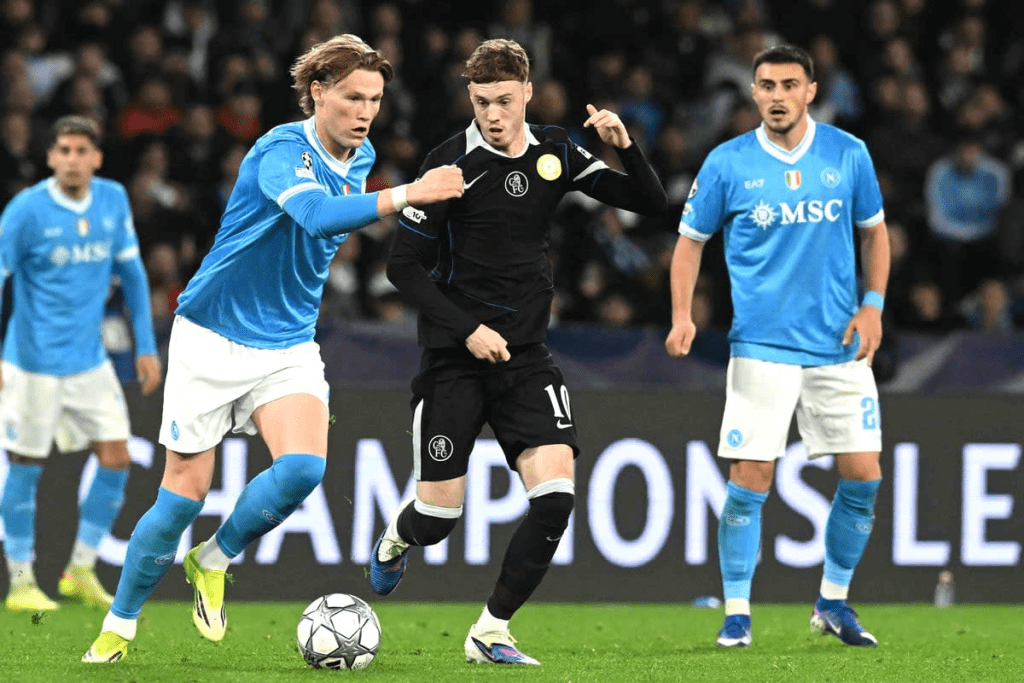
Cole Palmer did not enter the pitch simply to “change the game.” His introduction was targeted.
By the time Palmer came on, Napoli’s midfield line had dropped a few meters deeper, wary of Chelsea’s increased central presence. Palmer operated between the lines, forcing Napoli’s defenders to step out and leaving gaps behind.
The result was immediate. His assist for João Pedro’s winning goal was not a moment of improvisation—it was the consequence of spatial pressure built over 20 minutes.
This was a substitution made after control had been established, not before. That distinction matters.
João Pedro’s Role: More Than Just Two Goals

João Pedro scored twice, but his contribution extended beyond finishing.
He occupied Napoli’s center-backs intelligently, allowing Chelsea’s midfield runners to arrive late rather than fight for space early. His equalizer came from a quick sequence that started with controlled possession, not desperation.
The winning goal—created through Palmer’s vision—was the final expression of a tactical shift that had been developing since halftime.
What This Result Means for Chelsea’s Champions League Campaign
The immediate reward was clear: direct qualification to the Round of 16, sparing Chelsea an extra playoff round in an already congested calendar. For context on how qualification affects scheduling, Chelsea’s upcoming European and domestic workload is outlined in the Chelsea Match Schedule January–May 2026.
More broadly, this performance aligned with the evolving narrative of the Champions League 2026 knockout phase, where tactical adaptability has become as valuable as squad depth (see Champions League 2026 Knockout Phase).
Rosenior’s Growing Identity at Chelsea
This win will not define Liam Rosenior’s Chelsea tenure on its own. But it does underline something important: Chelsea are beginning to win matches through problem-solving, not reaction.
Earlier in the season, questions surrounded Rosenior’s future after domestic setbacks, including the loss to Arsenal. That context makes this result even more significant (related analysis: Liam Rosenior Future After Arsenal Loss).
In Naples, Chelsea did not chase the game emotionally. They reshaped it.
Conclusion: Why This Was a Coach’s Victory
The Liam Rosenior impact on Chelsea vs Napoli was subtle, calculated, and effective. This was not a comeback driven by chaos or luck, but by structural clarity and timing.
For Chelsea supporters, the result offers reassurance. For European rivals, it offers a warning: Chelsea are no longer just surviving big nights—they are learning how to control them.
Sources & References
- UEFA Champions League official match centre – Chelsea vs Napoli
https://www.uefa.com - Sky Sports – Napoli 2–3 Chelsea match report
- ESPN – Champions League statistics and post-match analysis
- Chelsea FC official site – post-match reactions and squad updates
