
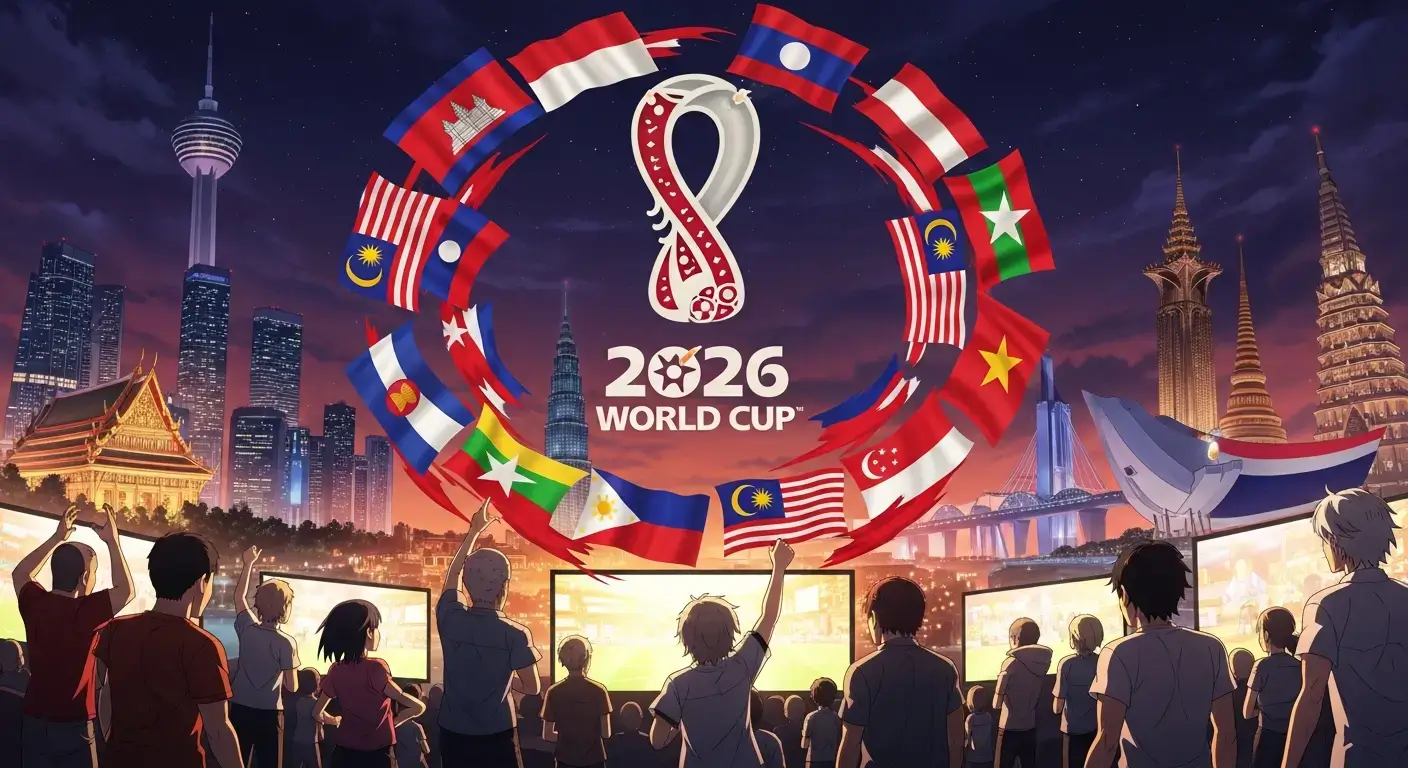
The broadcasting landscape for the FIFA World Cup 2026 within the Association of Southeast Asian Nations (ASEAN) serves as a critical barometer for the broader evolution of the global media economy. As the tournament moves toward its first-ever 48-team iteration, featuring a massive expansion to 104 matches, the logistical and financial stakes for regional broadcasters have reached an unprecedented zenith.
The Paradigm Shift in Global Rights Management
The 2026 World Cup cycle represents a watershed moment in how sports rights are commodified and distributed in Asia. Historically, FIFA relied on intermediaries, most notably the Swiss agency Infront Sports & Media, to handle the complexities of the Asian market. In the 2019–2022 cycle, Infront managed sales for 26 Asian countries, acting as the primary point of contact for broadcasters in territories ranging from Indonesia to Vietnam.
This institutional shift allows FIFA to manage its broadcast relationships directly, potentially maximizing revenue by eliminating agency commissions and gaining more granular control over how the World Cup brand is presented in emerging markets. Despite this centralized approach, the legacy of agency influence remains; FIFA has retained Infront as an advisor in specific ASEAN territories, including Singapore, Malaysia, Thailand, Indonesia, Vietnam, the Philippines, Myanmar, Laos, and Cambodia.
The procurement timeline for the ASEAN region was phased, beginning with invitations to tender (ITTs) for Laos, Malaysia, and Thailand in March 2025, with a bid deadline of April 1, 2025. Subsequent tenders for Myanmar and Cambodia were launched in September 2025.
Indonesia: The Resurgence of Public Service Broadcasting
Indonesia presents the most striking example of state-directed media strategy for the 2026 World Cup. In a departure from the 2022 tournament, where rights were held by the private media giant Emtek (parent of Vidio and SCTV), the 2026 rights have been secured by the public service broadcaster Televisi Republik Indonesia (TVRI).
Strategic Acquisition and Presidential Directives
The procurement process was described by TVRI’s leadership as a “long series of stages” that was “certainly not easy”. The involvement of President Prabowo Subianto provided the necessary policy direction and support to ensure that all 104 matches would be available free-to-air (FTA) across the archipelago.
| Entity | Role | Transmission Type | Focus |
|---|---|---|---|
| TVRI Nasional | Primary Rights Holder | Free-to-Air (Digital) | Nationwide reach, marquee matches |
| TVRI Sport | Dedicated Channel | Free-to-Air (Digital) | Full 104-match inventory, live and reruns |
| Garuda TV | Sub-licensee | Terrestrial/Satellite | Supplementary regional coverage |
| Dispenad | Strategic Partner | Public Viewing | Community engagement, security, outreach |
Socio-Economic Integration and Public Viewing
A unique aspect of Indonesia’s coverage is the collaboration between TVRI and the Army Information Service (Dispenad) to host massive public viewing events nationwide. This partnership leverages the extensive reach of the military’s local communication networks to organize group viewings in communities, aiming to stimulate the local economy by involving micro, small, and medium enterprises (MSMEs).
Thailand: Deregulation and the Rise of Digital Giants
In contrast to Indonesia’s state-led consolidation, Thailand has undergone a radical deregulation of its sports broadcasting market. The defining moment for the Thai market was the National Broadcasting and Telecommunications Commission’s (NBTC) decision in mid-2025 to remove the FIFA World Cup from its “Must-Have” list.
The End of the “Must-Have” Era
The removal of the World Cup from the “Must-Have” list was driven by the financial strain of high rights fees and a recognition that current viewing habits have shifted toward digital and private platforms. For Thai fans, this means that the 2026 tournament will likely be the first in decades where the majority of matches are behind a paywall.
| Market Segment | 2022 Status | 2026 Status | Primary Platforms |
|---|---|---|---|
| Regulatory | Protected (“Must-Have”) | Deregulated (Free Market) | NBTC oversight removed |
| Pay-TV | TrueVisions (Dominant) | JAS / MONOMAX (Rising) | Satellite, IPTV, Mobile App |
| Streaming | TrueID | MONOMAX / AIS Play | High-bandwidth 5G apps |
| Free-to-Air | 15+ Stations (Sub-licensed) | Limited (TBD) | Potential sub-licensing to MONO 29 |
AIS Play and MONOMAX: The New Ecosystem
The emergence of JAS and its partnership with AIS Play represents the “new normal” for Thai sports media. AIS Play and MONOMAX are positioned as the primary homes for premium football content, offering 4K streaming and affordable monthly packages. While JAS has not yet confirmed the full acquisition of the World Cup rights by January 2026, its existing infrastructure and exclusive EPL deal make it the most logical candidate for premium distribution.
Malaysia: The Stability of the Hybrid Model
Malaysia maintains a more traditional but highly effective hybrid model, balancing the extensive reach of the state broadcaster RTM (Radio Televisyen Malaysia) with the premium offerings of the satellite giant Astro.
Astro’s Comprehensive Coverage
Astro remains the primary destination for comprehensive World Cup coverage in Malaysia. As a leading pay-TV provider, it typically secures rights to broadcast every match live, supplemented by high-definition feeds, expert analysis, and interactive features. Astro’s digital ecosystem, including the Astro GO app and the sooka streaming service, allows subscribers to watch matches on multiple devices.
| Platform | Channel / App | Transmission | Accessibility |
|---|---|---|---|
| RTM | TV2, Okey, Sukan RTM | Digital Terrestrial | Free for all with antenna |
| MYTV | MYTV Mana-Mana | OTT Streaming | Free digital access |
| Astro | Astro SuperSport, Astro GO | Satellite / IPTV | Subscription (All Matches) |
| sooka | sooka App | OTT Streaming | Monthly/Daily Passes |
RTM and the Public Service Mandate
RTM, in partnership with the digital infrastructure provider MYTV, ensures that the most important matches—the opening ceremony, semi-finals, and final—are accessible to all Malaysians for free. In the 2022 cycle, RTM aired 27 live matches and 14 delayed telecasts. For 2026, RTM is expected to follow a similar pattern, prioritizing high-viewership fixtures.
Singapore: The Joint-Acquisition Paradigm
Singapore’s strategy is perhaps the most collaborative in the region. The “big three”—Singtel, StarHub, and Mediacorp—have established a successful precedent of joint bidding for major football tournaments.
Collaborative Distribution and Consumer Choice
By bidding together, the three broadcasters can offer standardized pricing and synchronized content across their respective platforms:
- StarHub: Distribution via StarHub TV+ and IPTV platforms (Channels 251/252)
- Singtel: Distribution via Singtel TV, Singtel TV GO (Channels 141/142), and the CAST app
- Mediacorp: Digital streaming of all 104 matches via the meWATCH service, with selected matches on free-to-air Channel 5
Regulatory Framework: Cross-Carriage and Competition
Singapore’s Media Development Authority (MDA) plays a crucial role in shaping this landscape. The “cross-carriage” rules require that any exclusive content secured by one pay-TV operator must be made available on rival platforms to prevent anti-competitive behavior. However, the joint bid model effectively sidesteps these regulatory hurdles.
Indochina and Beyond: Regional Trends
In Vietnam, negotiations for the 2026 World Cup are spearheaded by the national broadcaster Vietnam Television (VTV) and its cable affiliate VTVcab. VTVcab has been aggressive in securing European rights and is currently positioning itself to bring the 2026 tournament to Vietnamese audiences via both free-to-air and its VTVprime app.
In the smaller markets of Laos and Cambodia, the broadcasting rights are increasingly tied to larger regional deals. In Myanmar, the satellite operator SkyNet continues its long-term relationship with FIFA, having held the rights for the 2014, 2018, and 2022 cycles.
| Country | 2026 Projected Lead Broadcaster | Context |
|---|---|---|
| Vietnam | VTV / VTVcab | Direct FIFA negotiation, mixed FTA/App |
| Myanmar | SkyNet | Established satellite incumbent |
| Cambodia | Hang Meas / CBS | Shift toward regional streaming partners |
| Laos | TBD (Tender March 2025) | High potential for regional JAS sub-license |
| Philippines | Tap DMV (2022 Incumbent) | Focus on premium pay-TV and OTT |
The Logistics of Time: Managing the “Graveyard Shift”
The geographical location of the 2026 World Cup—hosted by the USA, Canada, and Mexico—presents a significant logistical challenge for the ASEAN region. The time difference is roughly 11 to 15 hours, meaning that matches played in the North American afternoon and evening occur in the dead of night or early morning in Southeast Asia.
Impact on Viewership Habits
For broadcasters, this time difference necessitates a change in programming strategy. Live matches will predominantly air between 11:00 PM and 11:00 AM local time in most ASEAN markets.
- On-Demand Streaming: Fans who miss matches due to sleep or work will rely heavily on catch-up services and match highlights
- Mobile Accessibility: Early morning kick-offs (6:00 AM to 9:00 AM) coincide with the morning commute, making high-quality mobile streaming apps essential
- Delayed Telecasts: Broadcasters like TVRI and RTM will utilize delayed broadcasts during peak evening hours (7:00 PM to 10:00 PM)
| US Time (ET) | WIB (Jakarta) | SGT/MYT (Singapore/KL) | Match Status |
|---|---|---|---|
| 1:00 PM | 12:00 AM (Next Day) | 1:00 AM (Next Day) | Early Kick-off |
| 4:00 PM | 3:00 AM (Next Day) | 4:00 AM (Next Day) | Mid-afternoon Kick-off |
| 7:00 PM | 6:00 AM (Next Day) | 7:00 AM (Next Day) | Evening Kick-off |
| 10:00 PM | 9:00 AM (Next Day) | 10:00 AM (Next Day) | Late Kick-off |
Commercial Opportunities and Advertising Trends
The expansion from 32 to 48 teams increases the total matches from 64 to 104, providing a 62.5% increase in advertising inventory. For ASEAN broadcasters, this expansion offers a longer period of high-intensity engagement (nearly six weeks) but also requires a more sophisticated advertising strategy to sustain momentum.
Ad-Tech and Digital Monetization
In markets like Singapore and Thailand, broadcasters are leveraging “Addressable TV” and targeted digital advertising within their OTT apps. This allows advertisers to target specific demographics with personalized ads during live streams.
🏆 New Opportunity: Super Bowl-Style Half-Time Show
The introduction of a Super Bowl-style half-time show for the World Cup final provides a new, high-value sponsorship slot that did not exist in previous cycles.
Broadcasters are also exploring “Micro-Sponsorships,” where local businesses can sponsor specific match segments or public viewing zones. This is particularly prevalent in Indonesia, where TVRI’s collaboration with MSMEs is designed to spread the economic benefits of the tournament.
Public Viewing Regulations: The FIFA License Framework
For many fans in Southeast Asia, the World Cup is a social event experienced in bars, restaurants, and public parks. However, any organized gathering where matches are shown to an audience outside a private home is classified as a Public Viewing Event (PVE) and is subject to strict FIFA regulations.
Licensing Tiers and Compliance
Organizers must apply for a license via FIFA’s dedicated portal, which became active in late 2025. The regulations distinguish between:
- Commercial PVEs: Events where an entry fee is charged or where the organizer secures their own sponsors. These require a commercial license and a fee paid to FIFA.
- Non-Commercial PVEs: Community-led events with no entry fee and no commercial sponsors. These may be free of charge but still require a license for authorization.
Conclusion: A Diverse yet Connected Media Future
As of late January 2026, the ASEAN region stands ready for a transformative World Cup experience. The transition from agency-led rights sales to direct FIFA management has spurred a wave of modernization across regional broadcasters. Indonesia’s state-led FTA model provides a stark contrast to Thailand’s deregulated, digital-first landscape, while Singapore and Malaysia continue to refine their collaborative and hybrid strategies.
The challenges of the North American time zones and the expansion to 104 matches have acted as a catalyst for technological innovation, with OTT platforms and 5G-enabled mobile apps now serving as the primary way millions of Southeast Asians will engage with the tournament. Ultimately, the 2026 FIFA World Cup will be remembered in ASEAN not just for the action on the pitch, but as the moment when the region’s sports media landscape fully embraced the digital age.
